The Real Results of Liposuction in NYC: What Changes and What Doesn’t
There exists an abstraction of liposuction, one that is constructed out of people’s heads before they do their homework. Fast, impressive results and hardly any recovery time. That version is not accurate. Where the expectation of that and the actual reality that befalls is probably where a lot of patient disappointment comes from.
A far more realistic choice is knowing what liposuction near me really produces, and just as important, what it does not. The procedure works. For the right candidates, it does work well. However, “works well” has a specific meaning in this context, and you need to break it down before you decide anything.
What Liposuction Actually Removes
Let’s break it down. Liposuction removes localized fat deposits. This is done using a thin hose called a cannula, which the surgeon inserts into small incisions to break up and suck out fat cells in a targeted area. Fat cells removed during liposuction in NYC do not return. That part is accurate. When a fat cell is gone, it is really gone. Future weight gain is reversible. How this does change is that the remaining fat cells in that region and in other places of the body can still expand. Which means that the contour enhancement you have following surgery isn’t permanent if you experience significant changes after the procedure.
What It Does Not Do
It is where expectations must be modified. Liposuction is NOT a weight loss treatment. It is common to remove one to five liters of fat in a session, which is equivalent to two to six pounds or more than that, depending on the density of the fat lost. Not much, but certainly not a number that moves the scale by very much.
Liposuction alone simply cannot tighten skin. For patients with skin that has lost its elasticity due to age, previous weight fluctuations, or genetics, liposuction can sometimes leave the skin looking loose instead of smooth. So, one of the more common but surprising things patients may experience following surgery is that it makes sense to discuss directly with your surgeon before coming to any determinations.
Liposuction also does not always improve cellulite. Cellulite is a problem of structure that sits at the level of the tissue, whereas the fat liposuction removes is not addressed. Some patients see mild improvement. Others see no change. The assumption that liposuction is the solution for cellulite leads to a result that many surgeons would not guarantee.
Which Areas Respond Best
Liposuction gives better results in some body areas than others. Here is a general breakdown:
- Abdomen and flanks: One of the most commonly treated areas, with often pleasing contouring results achieved when skin elasticity is satisfactory.
- Thighs: inner and outer thighs are good responders in the case of localized fat deposits and skin quality
- Results: May provide good results; however, skin laxity is more common in this area.
- Back and bra line: A seldom-talked-about but real area for targeted fat treatment.
- Neck and jawline: Submental liposuction may show visible results, especially in younger patients with good skin quality and a tight neck.
More diffuse fat distribution or skin with significant loss of elasticity are areas where results are less predictable. The general list means a lot less than your surgeon’s specific assessment of how your anatomy is.
The Timeline For Seeing Results
Waiting may be the most difficult aspect of liposuction recovery. Swelling subsequently can be quite prominent, and in fact, in some patients, the treatment area appears bigger immediately post-surgery than it did prior to surgery. This is absolutely normal in a human-computer process and is not indicative of anything being wrong.
Patients usually notice early contouring results at four to six weeks during the resolution of initial swelling. More complete results take longer. Most of the swelling goes away in three months. At six months to a year, final results may be seen when the contour has settled after full swelling and residual swelling resolves.
Compression garments truly have a role in this process you’ve got going on. Continued wear as directed helps your skin begin settling into the new contour beneath and can increase the amount of time your swelling will subside.
What Recovery Actually Looks Like
Sore, bruised, swollen areas about the size of a large grape in each area for 1st week. Most patients characterize the discomfort as bearable rather than severe; however, this varies depending upon the number of areas treated and the person’s level of pain tolerance.
The majority of patients are able to return to a desk job in one or two weeks. Physical activity takes longer. Gentle walking is allowed right away, but anything that raises your heart rate significantly or strains the areas treated often doesn’t happen until four to six weeks after surgery (and longer in some protocols depending on each individual surgeon’s guidance).
Fluid draining from the small incision sites in the first few days is normal. So is asymmetric swelling between the sides. The asymmetry is that our body heals itself, and that this asymmetry is gradually balanced over time.
The Part Most People Forget To Think About Until Many Years After
Maintenance. While liposuction permanently alters the distribution of fat cells, the quality of results over time is still dependent on lifestyle. Major tissue redistribution, which happens because of significant weight gain after the system, prompts irregularities in the basic form. Maintaining a distance of 20 lbs from your surgery weight maintains the benefits of that procedure.
This isn’t a reason to shy away from having liposuction. It is simply the portion of the conversation that may not get hit as hard in all of the pre-surgery excitement, but it is critical for expectation management over a lengthy period post-op.
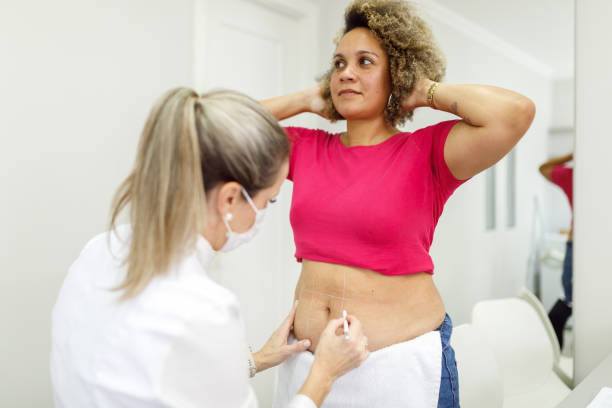
Featured Image Source: https://media.istockphoto.com/id/1471734083/photo/beautician-marking-clients-body-before-a-cosmetic-procedure.jpg?b=1&s=612×612&w=0&k=20&c=WZOtX4AbhFLqaZRAmTutjnthfKwo-w5w365D1lUAGnk=